
Travel Tips
How to Stay Safe While Traveling: 15 Tips to Avoid Pickpockets, Theft & Lost Valuables
October 1, 2026
Disclosure: Some links in this post may be referral or affiliate links. If you use them, we may earn a commission at no extra cost to you. See our Affiliate Disclosure.
Travel is supposed to be fun. The last thing you want to spend your vacation doing is dealing with a stolen phone, missing wallet, lost passport or bag that disappeared somewhere along the way.
Unfortunately, I learned one of these lessons the hard way.
My phone was stolen in Barcelona.
And if you've ever had your phone disappear while you're in another country, you know that it's not just losing a phone. Your phone has your photos, boarding passes, hotel information, credit cards, email, maps, passwords and pretty much your entire life on it.
Since then, I've become much more careful about how we carry our things when we travel.
I'm not suggesting you spend your vacation worried that someone is going to steal from you. We certainly don't. But there are some really simple things you can do before and during a trip that can make you a much harder target.
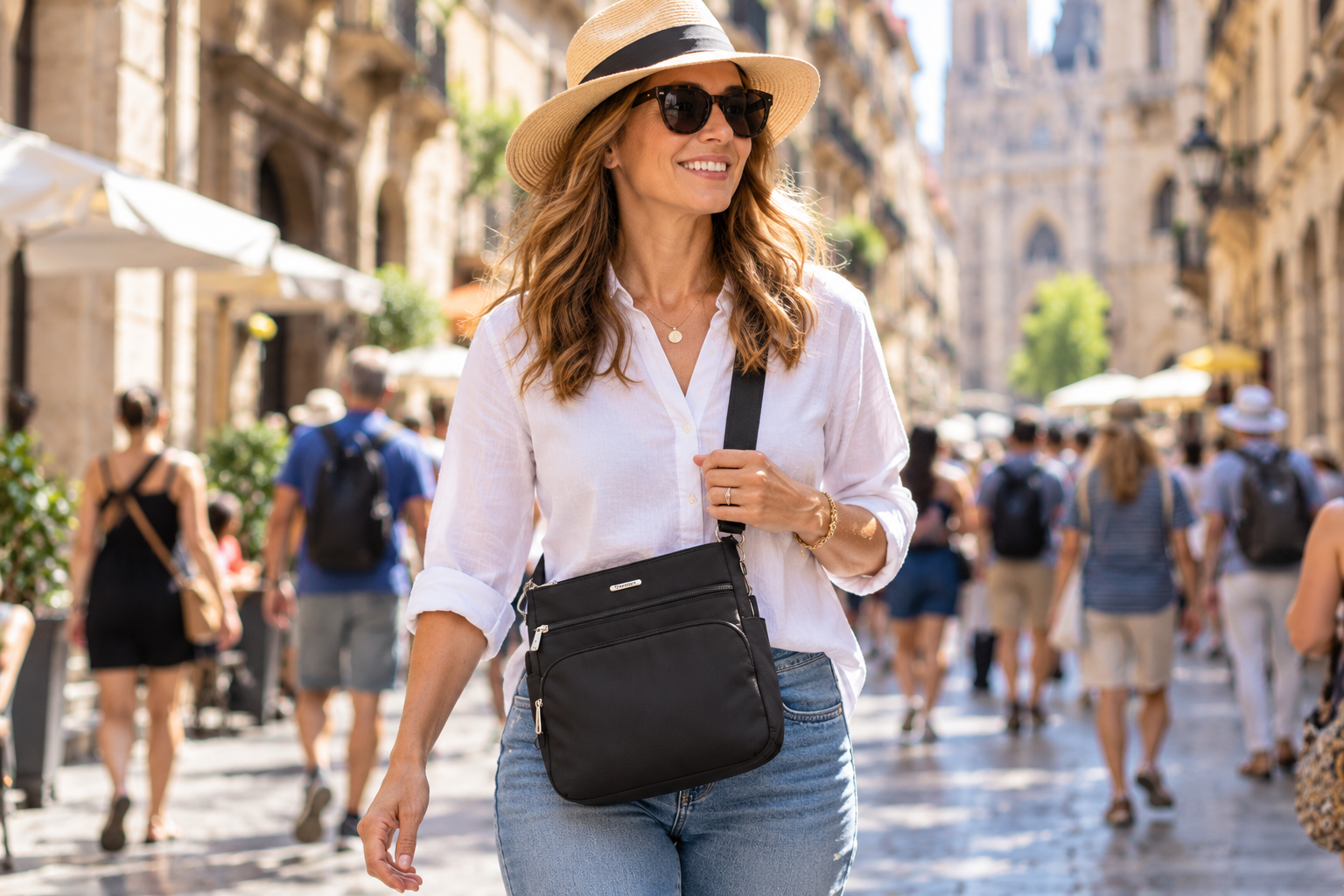
1. Use a secure crossbody bag
This is probably my #1 recommendation, especially in busy European cities.
I love Travelon anti-theft crossbody bags because they're designed specifically for travel. Many have locking zippers, slash-resistant construction and RFID-blocking compartments. There are other secure bag brands available now, but Travelon is my favorite. They come in all different styles, shapes and sizes.
My favorite Travelon bags: Shop Travelon Bags
The important part isn't just having a crossbody bag — it's how you wear it.
Keep it across your body, zipped and in front of you when you're in crowded places. Don't leave your phone sticking out of an exterior pocket, and don't hang your purse over the back of a restaurant chair.
Pay extra attention in places where people naturally get close to you: subways, train stations, escalators, crowded attractions, street performances and busy plazas.
2. Men need a plan too
I think women sometimes think more about securing a purse because we're used to carrying one. Men may throw a wallet into a back pocket and not think twice about it.
When we're traveling, I recommend pants or shorts with secure pockets and a slim wallet rather than carrying your entire wallet from home.
Take what you need for that day:
• One credit card
• A small amount of cash
• Your ID as needed
Leave extra credit cards somewhere secure rather than carrying every card you own at the same time. That way, losing one wallet doesn't leave you with absolutely no way to pay for anything.
Travelon also makes anti-theft sling bags and backpacks for men, which are a great alternative to stuffing everything into pockets.
Travelon men's sling bag: Shop Sling Bags
RFID blocking slim wallet: Shop Wallets
3. Protect your PHONE
If you take only one thing from this post, please protect your phone.
I learned this one the hard way in Barcelona.
Today's smartphones can cost well over $1,000, but the cost of replacing the phone isn't even the biggest problem. Think about what is accessible through your phone: email, banking apps, credit cards, photos, travel reservations and potentially your passwords.
Now I use a phone lanyard/crossbody phone holder when we're traveling.
Here are three options.
BEST: Bandolier Lanyard
This is what I'd choose if you travel frequently and want something you'll actually use all the time.
GOOD: MID-PRICE OPTION
A good balance between price and security.
WORKS: INEXPENSIVE OPTION
It doesn't need to be fancy. The important thing is that your phone is physically attached to you.
The goal is simple: don't make it easy for someone to grab your phone out of your hand or pocket and disappear into a crowd.
4. Change these settings on your phone BEFORE you leave
This takes a few minutes and could make a huge difference if your phone disappears.
First, make sure Find My iPhone is turned on.
Next, I recommend turning off access to Control Center while your phone is locked. Otherwise, someone holding a locked iPhone may be able to access Control Center and Airplane Mode. Go to:
Settings → Face ID & Passcode → Allow Access When Locked → Turn OFF Control Center
Also turn on Apple's Stolen Device Protection.
If your iPhone is stolen, Apple's Find My system lets you locate it, mark it as lost and display contact information on the screen. Stolen Device Protection adds additional safeguards against someone making critical account changes even if they know your passcode.
One more thing we do: share our locations with each other while traveling.
If we're separated, or someone's phone disappears, another person in our group can immediately open Find My and see its location.
5. Put an emergency contact number on your Lock Screen
This is such an easy thing to do.
Consider creating a Lock Screen wallpaper that includes something like:
IF FOUND: +1 XXX-XXX-XXXX
Use your spouse's or travel companion's number — not the number of the phone you're holding.
If you accidentally leave your phone in a taxi, restaurant, airport lounge or hotel lobby and an honest person finds it, you've just given them an easy way to get it back to you.
6. Carry your passport securely
When traveling internationally, know the identification requirements for the country you're visiting. Some countries require foreign visitors to possess valid identification or travel documents (Italy, for example, and others).
I personally prefer to keep my passport on me and secured, rather than leaving it behind in the hotel. I leave the copies of my passport in the hotel.
But that absolutely does NOT mean carrying it in an easy-to-access purse pocket.
Use a hidden money belt, secure interior pocket or anti-theft bag, like the Travelon bags already mentioned.
Money belt I recommend: Shop Money Belts
And don't put everyone's passports together in an easily accessible outside pocket. Losing one passport is a problem. Losing the entire family's passports at once is a much bigger problem.
7. Keep copies of your passports separately
Before leaving home, make copies of everyone's passport information page.
Keep a copy separate from the actual passports — for example, secured with your other travel documents at the hotel, and send a digital copy to a family member traveling with you that you can access if necessary.
You can also leave a copy with a trusted family member at home.
A copy won't replace a passport, but having your passport information available can be extremely helpful if the original is lost or stolen.
8. Use luggage locks
We use locks on our luggage, particularly when bags are going to be out of our sight.
If you're flying in the United States, make sure the lock is TSA-recognized, meaning TSA officers can open it with the appropriate tools if your bag needs to be inspected.
TSA-approved luggage locks: Shop Luggage Locks
A luggage lock isn't going to make a suitcase impenetrable. The point is to add another layer of protection and make your bag less convenient to open.
9. Put luggage tags on EVERYTHING
Most people put a luggage tag on a checked suitcase.
I put identification on much more than that.
Tag your:
• Checked luggage
• Carry-on
• Backpack
• Personal item
And put contact information inside the bag too.
Exterior tags can get ripped off. If your bag is found and someone opens it looking for identification, having your contact information inside gives you another chance of getting it back.
For privacy, you don't necessarily need your full home address displayed prominently on the outside. A name, phone number and/or email address can be enough.
Luggage tags: Shop Luggage Tags
10. Put an AirTag in your luggage
We use Apple AirTags in our luggage in addition to luggage tags.
Apple AirTags: Shop Air Tags
They're useful for checked luggage, but I also like them in carry-ons and other important bags.
An AirTag isn't a replacement for a luggage tag, and it can't prevent a bag from being stolen. It's simply another tool that may help you determine where a missing bag is.
11. Enroll in STEP before an international trip
This one is completely FREE.
The U.S. Department of State's Smart Traveler Enrollment Program (STEP) allows U.S. citizens traveling abroad to register their trip and receive alerts from the U.S. embassy or consulate for their destination.
You can receive information about security issues, demonstrations, severe weather, emergencies and changes to Travel Advisories.
It can also make it easier for the embassy or consulate to contact you or your emergency contact during an emergency.
Enroll in STEP: Enroll Here
12. Give someone at home your itinerary
Before we leave the country, someone at home should know where we're supposed to be.
Give a trusted family member:
Your flight information, hotel names and addresses, travel dates, basic itinerary and a way to contact you.
This doesn't have to be complicated. Forwarding hotel confirmations and flight information may be enough.
If something happens, someone at home shouldn't have to start figuring out what hotel you're staying at in Rome.
13. Watch for distraction — that's often the point
Pickpocketing isn't always someone quietly reaching into your pocket.
Sometimes the distraction is part of the theft.
Someone bumps into you. Someone asks you a question. Something spills on you. A crowd suddenly forms. Someone gets unusually close while you're trying to buy a train ticket.
You don't need to assume everyone approaching you has bad intentions. Just be aware that when your attention suddenly goes in one direction, it's a good time to put a hand on your bag and phone.
And be especially alert when you're dealing with luggage. It's easy to become distracted while buying tickets, checking a map or figuring out which train you're supposed to take.
14. Don't flash everything you have
You don't need to pull out a wallet stuffed with cash in the middle of a crowded tourist area.
Keep small amounts of cash easily accessible for the day and keep the rest secured.
The same goes for expensive jewelry and electronics. There's no reason to advertise what you're carrying.
15. Don't put valuables where you can't see them
A few simple rules I follow:
Never put a phone in an open back pocket.
Don't hang a purse on the back of a restaurant chair.
Don't leave a phone sitting on the edge of an outdoor café table.
Don't put a wallet or passport in an easily accessible backpack pocket.
On public transportation, move backpacks to the front of your body or keep them where you can see them.
And when you're sitting down, keep your bag attached to you or secured between your feet — not sitting unattended next to your chair.
My basic travel-safety setup
You don't need to travel scared. You just want to make yourself a less convenient target.
Before an international trip, these are the things I think about:
Secure crossbody bag or anti-theft sling + phone lanyard + money belt when needed + TSA-recognized luggage locks + luggage tags + AirTags + copies of passports + Find My/location sharing + STEP enrollment.
Most of these things take just a few minutes to set up before you leave.
And after having my phone stolen in Barcelona, I can tell you I'd much rather spend those few minutes before a trip than spend hours of my vacation dealing with something that was lost or stolen.
What to do if you ARE pickpocketed or something is stolen?
Even if you do everything right, theft can still happen. If it does, don't spend an hour hoping your wallet or phone is going to turn up.
The first few minutes matter.
If your credit or debit cards were stolen, lock them immediately.
Open your bank or credit card app and lock or freeze the missing cards. Then contact the card issuer and report them stolen. Check your recent transactions while you're there and report anything you don't recognize.
If you can't reach your bank, the major card networks also have emergency assistance numbers for travelers. Before you travel, save the appropriate numbers somewhere you can access even if your phone and wallet are both stolen.
If your phone was stolen, act quickly.
This is the one I learned the hard way in Barcelona. Use another device to access Apple's Find My or the equivalent service for your phone. Mark the device as lost and contact your wireless carrier if necessary. If you were traveling with someone and sharing locations as I recommended above, they may also be able to see the phone's last known location.
Don't put yourself in danger trying to physically retrieve a stolen phone. If you can see its location, give that information to local police.
File a police report.
If your wallet, passport, phone or other valuable item was stolen, report the theft to the local police as soon as possible.
Be prepared to tell them:
• Exactly what was stolen
• Approximately when it happened
• Where you were when it happened
• How you believe it happened
• Any identifying information you have for the stolen items
Ask for a copy of the police report. You may need it for travel insurance, replacement documents, credit-card disputes or other claims.
If your passport was stolen, contact the nearest U.S. embassy or consulate.
You'll need to report the passport stolen and arrange for a replacement. This is one of the reasons I recommend keeping a copy of your passport separate from the original and having a protected digital copy you can access.
The U.S. embassy or consulate can tell you exactly what you'll need and whether an emergency passport is appropriate for your situation.
One more thing to do BEFORE your trip
Save your important emergency information somewhere other than your wallet—and don't make your phone the only place you keep it.
That should include your credit-card issuers' international contact information, passport information, travel-insurance information, hotel details and an emergency contact at home.
If your phone and wallet disappear at the same time, you'll be very glad you did this.
Travel smart, protect the things that matter, and then go enjoy your trip.
SHOP ALL MY TRAVEL SAFETY ESSENTIALS: Shop all Here