
Travel Tips
Travel Insurance Explained: Coverage, Costs & How to Compare
October 28, 2026
Disclosure: Some links in this post may be referral or affiliate links. If you use them, we may earn a commission at no extra cost to you. See our Affiliate Disclosure.
You've booked your flights, reserved your hotel, and planned your itinerary. But there's one more thing worth thinking about before you leave: travel insurance.
Do you really need it? Doesn't your credit card already cover you? What about your regular health insurance?
And what's the difference between travel insurance, travel medical insurance, and medical evacuation coverage?
It can get confusing pretty quickly!
The good news is that you may already have some coverage through your credit cards or health insurance. But there can be some pretty important gaps, especially when you're traveling internationally.
I'm a big believer in not paying for insurance you don't need. But I'm also a big believer in understanding exactly what you're covered for before something goes wrong.
Let's break down the different types of travel insurance, what you may already have, and how to compare policies without spending more than necessary.
Not sure what travel insurance you need? Compare policies on Squaremouth.
1. What Is Travel Insurance, Anyway?
Travel insurance isn't just one type of coverage. It's actually a collection of different protections designed to help when something unexpected happens before or during your trip.
Depending on the policy, travel insurance can help with:
- Trip cancellation: You need to cancel your trip before leaving.
- Trip interruption: Something happens during your trip and you need to come home early.
- Travel delays: Your flight is delayed and you're stuck paying for a hotel or meals.
- Lost or delayed luggage: Your suitcase doesn't arrive when you do.
- Emergency medical treatment: You get sick or injured while traveling.
- Medical evacuation: You need specialized transportation to an appropriate hospital.
- Cancel For Any Reason (CFAR): You want the flexibility to cancel for a reason that wouldn't normally be covered.
Here's what many travelers don't realize: You don't necessarily need all of these protections.
For example, if you've booked refundable hotels and flights using points, you might not have much money at risk if you cancel.
But if you're traveling internationally and your health insurance doesn't cover you overseas, medical coverage could be extremely important.
The trick is figuring out what you actually need.
2. Trip Cancellation and Trip Interruption Insurance
These are probably the types of travel insurance people are most familiar with.
Trip Cancellation Insurance
Let's say you've booked a $6,000 family vacation, but a week before departure, someone gets seriously sick and you can't go.
Trip cancellation insurance may reimburse your prepaid, non-refundable expenses if the cancellation is for a covered reason.
Common covered reasons can include:
- Serious illness or injury
- Death of a covered family member or traveling companion
- Certain severe weather events
- Jury duty or other qualifying legal obligations
- Other unexpected events specifically listed in your policy
The key phrase here is covered reason.
Just deciding you don't want to go anymore usually isn't covered.
Trip Interruption Insurance
This works similarly, but protects you after your trip has already started.
Imagine you're halfway through a two-week European vacation when a family emergency forces you to return home.
Depending on the policy and reason, trip interruption coverage may reimburse unused, non-refundable portions of your trip and certain additional transportation expenses.
My tip: Before buying cancellation insurance, look at how much money you would actually lose if you couldn't take your trip. If most of your reservations are refundable, you may not need as much coverage.
3. What Is Cancel For Any Reason Insurance?
This is a popular option for travelers who want more flexibility.
Standard trip cancellation insurance only covers specific reasons listed in the policy.
Cancel For Any Reason (CFAR) coverage is an optional benefit on certain policies that allows you to cancel for reasons that wouldn't otherwise qualify.
Maybe you change your mind, become uncomfortable traveling to your destination, or simply decide the trip isn't right for you.
There are a few important catches:
- CFAR typically reimburses only a portion of your non-refundable trip expenses, often 50%–75%.
- You generally need to purchase it shortly after making your initial trip deposit.
- You may need to insure all eligible prepaid, non-refundable trip costs.
- You usually need to cancel at least 48 hours before departure.
CFAR also costs more than standard coverage.
Who should consider it? Travelers booking expensive, non-refundable trips who want more flexibility than a traditional policy provides.
4. Travel Medical Insurance: One of the Most Important Things to Check
This is where I think people really need to pay attention, especially when traveling internationally.
Many travelers assume their regular health insurance will cover them anywhere in the world.
Unfortunately, that's not always true.
Some U.S. health insurance plans cover emergency treatment overseas. Others provide limited coverage or none at all.
And even when your insurance covers international emergencies, you may have to pay the hospital upfront and submit a claim when you return home.
What Does Travel Medical Insurance Cover?
Depending on the policy, travel medical insurance can help pay for:
- Emergency doctor visits
- Hospitalization
- Emergency surgery
- Treatment for unexpected illnesses
- Treatment for injuries and accidents
- Certain prescription medications related to a covered emergency
Routine care, elective procedures, and pre-existing medical conditions may be excluded or subject to special rules.
Check Your Existing Health Insurance First
Before purchasing additional medical coverage, call your health insurance provider.
Ask these questions:
- Am I covered for emergency medical treatment outside the United States?
- Are overseas hospitals considered out-of-network?
- What are my deductibles and out-of-pocket limits?
- Will you pay foreign hospitals directly, or do I need to pay upfront?
- Are there limits on how much you'll reimburse?
- Does my plan cover emergency medical evacuation?
One more important point: Original Medicare generally doesn't cover medical care outside the United States, except in limited circumstances. Some Medicare Advantage and Medigap plans may provide additional international benefits.
If your existing insurance provides adequate coverage, you may not need a separate travel medical policy.
But if it doesn't, this is a gap worth addressing.
5. Medical Evacuation Insurance: Why It Matters
Medical evacuation coverage is different from medical treatment coverage.
And depending on where you're traveling, it can be one of the most important protections to consider.
Imagine you're visiting a remote part of the world and become seriously ill or injured.
The local hospital may not have the equipment or specialists needed to treat you.
You could need an air ambulance or other specialized transportation to reach an appropriate medical facility.
That can become incredibly expensive.
Medical evacuation costs can run into tens or even hundreds of thousands of dollars, depending on your location and the transportation required.
Doesn't My Health Insurance Cover That?
Not necessarily.
Your regular health insurance might cover your hospital bills but not the cost of transporting you to another medical facility.
And there's another important distinction.
Medical evacuation coverage doesn't necessarily mean you get flown home to the United States.
Many policies cover transportation to the nearest appropriate medical facility capable of treating your condition.
If your preference is to return to a hospital near home, you'll need to look carefully at the policy's transportation rules.
Some specialized evacuation memberships offer different options.
When We Traveled to Nepal
When we traveled to Nepal, we purchased a separate medical evacuation policy with a high coverage limit.
For me, that was worth the extra cost.
Traveling somewhere remote is very different from visiting a major city with excellent hospitals nearby.
My advice: Pay particular attention to medical evacuation coverage when visiting remote destinations, taking adventure trips, or traveling somewhere with limited medical facilities.
6. Flight Delays, Missed Connections, and Lost Luggage
These are the smaller travel headaches that can still cost you money.
Travel Delay Insurance
Imagine your flight is delayed overnight and you suddenly need a hotel, dinner, and transportation.
Travel delay coverage may reimburse reasonable expenses, subject to the policy's waiting period, limits, and covered reasons.
Missed Connection Insurance
If a covered delay causes you to miss a connecting flight, cruise departure, or tour, certain policies may help cover eligible additional expenses.
Not every missed connection qualifies, so read the details.
Baggage Insurance
Baggage coverage generally falls into two categories:
- Baggage delay: Reimbursement for essential purchases while your luggage is delayed.
- Lost or damaged baggage: Reimbursement for eligible belongings that are lost, stolen, or damaged.
Before buying additional coverage, check your credit card benefits. Many travel rewards cards already include some of these protections.
7. You May Already Have Travel Insurance Through Your Credit Card
Here's something I love about travel rewards credit cards: some include valuable travel protections just for being a cardholder and booking an eligible trip.
And if you use points and miles to travel, these benefits can be especially helpful.
Depending on the card, benefits may include trip cancellation, trip interruption, travel delays, lost luggage, baggage delays, rental car coverage, and even emergency medical evacuation.
But there are two important things to understand:
First, not every travel credit card includes the same benefits.
Second, even premium travel credit cards may have significant limitations on emergency medical treatment.
A Closer Look at Chase Sapphire Travel Insurance
Two popular cards for travel protections are the Chase Sapphire Preferred and Chase Sapphire Reserve.
Here's a quick comparison of selected benefits:
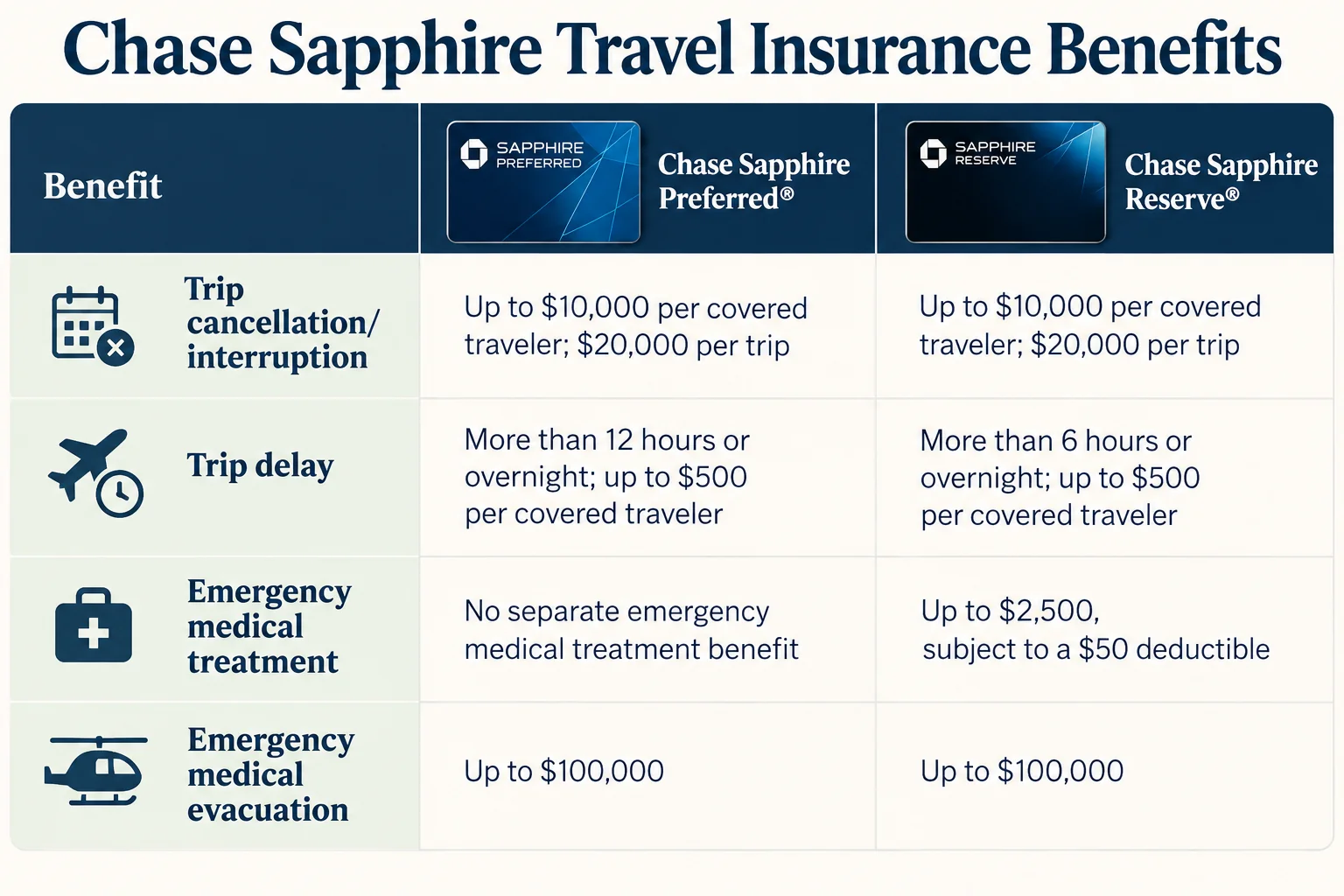
All benefits are subject to eligibility requirements, exclusions, and the current Guide to Benefits.
LEARN MORE HERE ABOUT THE CHASE SAPPHIRE CARDS
Important update: Chase added emergency evacuation and transportation coverage to the Sapphire Preferred card in June 2026.
That's a valuable improvement, but it doesn't mean the card provides comprehensive international medical insurance.
The Preferred still doesn't include a separate emergency medical treatment benefit, and the Reserve's $2,500 benefit could be far below the cost of a serious medical emergency.
You can review the current benefits directly through Chase's Travel Insurance Guide.
What If You Book Your Flights With Points?
Here's another benefit for points and miles travelers!
Some credit card travel protections can still apply when you book award flights.
For example, if you use airline miles for a flight and pay the taxes and fees with an eligible Chase Sapphire card, certain protections may apply.
Bookings made using eligible Chase Ultimate Rewards points may also qualify.
However, reimbursement for award travel may be limited to eligible cash expenses, fees, or other amounts defined by the benefit.
Always check the payment and booking requirements for your particular card.
My tip: When booking award travel, I like using a credit card with travel protections to pay the taxes and fees. Just make sure the booking qualifies.
8. How to Compare Travel Insurance Policies Without Overpaying
Now that you understand the different types of coverage, how do you figure out which policy to buy?
This is where a travel insurance comparison website can be really helpful.
Rather than visiting individual insurance companies and trying to compare dozens of policies yourself, you can use a comparison site to see multiple options in one place.
My Recommended Comparison Tool: Squaremouth
Squaremouth is a travel insurance comparison website that lets you compare policies from multiple insurance providers.
Think of it as a comparison shopping tool for travel insurance.
You enter your trip information, review available plans, and compare coverage and pricing side by side.
What I particularly like is that you can focus on the types of protection you actually need.
For example, you can compare policies based on:
- Emergency medical coverage limits
- Medical evacuation limits
- Trip cancellation and interruption benefits
- Cancel For Any Reason options
- Coverage for pre-existing medical conditions
- Primary versus secondary medical coverage
- Travel delays and baggage protection
- Price and provider ratings
You can also compare medical-only policies instead of automatically purchasing a comprehensive travel insurance package.
How I Would Use Squaremouth
Step 1: Check the coverage you already have.
Look at your credit card benefits and regular health insurance.
Step 2: Identify the gaps.
Maybe your credit card already provides enough trip cancellation coverage, but you need international medical insurance.
Or perhaps you're booking an expensive cruise and want additional cancellation protection.
Step 3: Compare policies on Squaremouth.
Enter your destination, travel dates, traveler information, and trip cost.
Review the policies that match your needs.
Step 4: Compare more than just the price.
Look at the coverage limits, exclusions, deductibles, medical evacuation rules, and whether medical benefits are primary or secondary.
Step 5: Read the actual policy before purchasing.
The cheapest policy isn't necessarily the best value if it doesn't cover what matters to you.
Affiliate disclosure: This article contains affiliate links. If you purchase a policy through one of my links, I may earn a commission at no additional cost to you. I only recommend resources I believe can be helpful to travelers.
9. How Much Does Travel Insurance Cost?
The cost depends on several factors, including your age, destination, trip length, total trip cost, and the coverage you select.
According to the National Association of Insurance Commissioners, comprehensive travel insurance policies generally cost around 5%–10% of the total trip price.
For example, on a $5,000 trip, that could mean roughly $250–$500 for a comprehensive policy.
But here's something important: You don't necessarily have to purchase comprehensive coverage.
If you only need travel medical insurance, a medical-only policy may be significantly less expensive.
That's one reason I recommend comparing options instead of automatically buying the insurance offered when booking a flight or cruise.
10. Do You Really Need Travel Insurance? A Few Examples
Every trip is different. Here's how I would think about it.
A Weekend Trip to New York City
You're staying at a refundable hotel and booking flights using points.
Your regular health insurance covers you domestically, and your credit card includes trip delay protection.
You may decide you don't need additional insurance.
A Two-Week European Vacation
You've booked several non-refundable hotels, train tickets, and tours.
Your health insurance has limited international coverage.
In this situation, I'd look closely at comprehensive travel insurance or at least additional travel medical and evacuation coverage, depending on the protections already available.
A Trip to a Remote Destination
You're traveling somewhere with limited medical facilities.
Even if you have good cancellation coverage, emergency medical treatment and evacuation limits may be the most important things to review.
An Expensive Family Cruise
You've prepaid thousands of dollars for a cruise, flights, and excursions.
Trip cancellation, interruption, medical evacuation, and cruise-specific benefits could all be worth considering.
And if you want the flexibility to cancel for reasons outside a standard policy, you might explore CFAR coverage.
The point is that there isn't one travel insurance policy that's right for everyone.
11. A Few Things to Check Before Buying Any Policy
Before purchasing travel insurance, make sure you understand:
- Pre-existing conditions: Are they excluded, covered, or eligible for a waiver?
- Primary versus secondary coverage: Will the travel insurer pay eligible claims first, or after your regular insurance?
- Medical evacuation rules: Who decides whether evacuation is medically necessary, and where can you be transported?
- Coverage limits: Are the limits per traveler, per trip, or per policy?
- Adventure activities: Are hiking, skiing, scuba diving, or other planned activities covered?
- Purchase deadlines: Do you need to buy coverage shortly after your first trip payment?
- Claim requirements: What receipts, medical records, or other documentation will you need?
One particularly important point: Some policies require you to contact their emergency assistance provider before arranging a medical evacuation.
Don't assume you can arrange an expensive flight yourself and get reimbursed later.
12. What Happens If You Need to File a Claim?
No one wants to think about filing an insurance claim on vacation, but a little preparation can make the process easier.
Before you travel, save a copy of your insurance policy and emergency assistance phone number.
If something goes wrong:
- Contact the insurance company's assistance team as soon as required, especially for medical emergencies or evacuation.
- Keep receipts for eligible expenses.
- Save airline notifications and written explanations of delays or cancellations.
- Request medical records and documentation when applicable.
- Submit your claim within the policy's deadlines.
And remember, insurance generally covers only the circumstances described in your policy. Simply having travel insurance doesn't guarantee every claim will be approved.
My Take: Protect Your Trip Without Paying for Coverage You Don't Need
I love using points and miles to make travel more affordable. But saving money on travel isn't just about flights and hotels.
It's also about being smart with the protections you already have.
Before every major trip, I think it's worth checking three things:
- Your credit card: What cancellation, delay, baggage, and evacuation protections do you already have?
- Your health insurance: Will it cover emergency medical treatment at your destination?
- The gaps: Do you need additional medical coverage, evacuation protection, or a comprehensive policy?
For me, medical evacuation is something I pay particular attention to, especially when traveling internationally or visiting remote destinations.
And if I need additional coverage, I prefer comparing several policies rather than just buying the first one offered to me.
That's why I like using Squaremouth. It makes it easier to compare options, understand the differences, and choose coverage that fits your particular trip.
You don't necessarily need the most expensive policy.
You just need to understand what you're buying and make sure you're comfortable with the coverage.
Safe travels!
Disclaimer: This article is for general educational purposes and is not insurance, legal, or financial advice. Coverage, exclusions, eligibility, and benefits vary by policy and may change. Always review the current policy documents and applicable credit card Guide to Benefits before relying on coverage.
Affiliate disclosure: Simply Points Travel may earn a commission if you purchase through certain links on this page, at no additional cost to you.

Disclosure: This is an affiliate link. If you buy travel insurance through Squaremouth, we may earn a commission at no extra cost to you. See our Affiliate Disclosure.