
Travel Tips
Traveling with Medication: What to Know Before You Fly
October 4, 2026
Disclosure: Some links in this post may be referral or affiliate links. If you use them, we may earn a commission at no extra cost to you. See our Affiliate Disclosure.
Packing for a trip is usually pretty straightforward, until you get to the medicine cabinet.
Can you put prescription medication in your carry-on? Does it have to stay in the original bottle? What about liquid medicine, insulin, injectable medications or medicine that needs to stay cold? And are the rules different when you're traveling internationally?
These questions come up all the time, and the good news is that traveling with medication is usually easier than people think. But there are a few things you should know before you leave, especially if you're traveling outside the United States.
Here’s a simple guide to traveling with prescriptions and over-the-counter medications.
1. Always Pack Medication in Your Carry-On
This is probably the most important rule I follow: don't put medication you need in your checked luggage.
TSA allows medication in both carry-on and checked baggage but recommends keeping medication in your carry-on when you may need immediate access to it.
There are several good reasons for this.
Checked luggage can be delayed, misrouted or lost. Your suitcase may also be exposed to temperatures that aren't appropriate for certain medications.
Keep your important medications with you in your personal item or carry-on bag where you can access them throughout your trip.
Simply Points Travel Tip: Pack enough medication for the entire trip plus a few extra days in case your return is delayed. CDC specifically recommends bringing extra medication for unexpected travel delays.
2. Do Prescription Medications Have to Be in Their Original Bottles?
For TSA screening within the United States, medications do not have to be in their original prescription bottles. However, individual states can have their own rules regarding prescription labeling.
That means your weekly pill organizer isn't automatically a TSA problem.
International travel is different.
If you're leaving the country, the CDC recommends keeping medications in their original, labeled containers. The label should clearly identify you, the medication and dosage.
Even if you normally use a pill organizer at home, traveling internationally is one situation where keeping prescription medications in their pharmacy containers can save you a lot of unnecessary explaining.
3. Bring a Copy of Your Prescriptions
For international trips, bring a copy of your written prescriptions, especially if you take important daily medications.
The CDC recommends that your documentation include the generic name of each medication as well as the brand name because medication brand names can vary from country to country.
It's also helpful to have a simple medication list containing:
• Your name
• Medication name
• Generic name
• Dosage
• Prescribing doctor
• Any important allergies
You can keep a paper copy with your travel documents and a digital copy on your phone.
For certain medications, controlled substances or injectable medications, ask your healthcare provider whether you should also carry a letter explaining why you need the medication and related supplies.
4. Liquid Medication Can Exceed the Normal TSA Liquid Limit
Here's one that surprises a lot of travelers.
The normal TSA 3-1-1 liquid rule doesn't apply in the same way to medically necessary liquids.
TSA permits medically necessary liquids, medications and creams in quantities greater than 3.4 ounces/100 milliliters in carry-on baggage. They do not have to fit inside your quart-size liquids bag.
You should tell the TSA officer that you're carrying medically necessary liquid medication at the beginning of the screening process. It may need to be screened separately.
So don't leave necessary liquid medication at home simply because the bottle is larger than 3.4 ounces.
5. What About Injectable Medications and Needles?
Many travelers now carry injectable medications, including insulin, EpiPens and other prescription injections.
If your medication requires needles, syringes or other supplies, pack everything you need together and keep it easily accessible.
For international travel, the CDC recommends getting a letter from your healthcare provider if you use injectable medications or controlled substances.
Depending on the medication, you may also need alcohol wipes and a safe way to dispose of used needles while you're traveling.
6. Traveling With Medication That Needs Refrigeration
Some medications need to remain within a specific temperature range, which requires a little more planning.
TSA allows accessories needed to keep medically necessary medications cold.
An insulated medication travel case or cooler may be useful, but don't assume your particular medication has to remain refrigerated every minute of your trip. Some refrigerated medications can safely remain at room temperature for a certain amount of time.
Check the storage requirements for your exact medication with your pharmacist, healthcare provider or the medication manufacturer before traveling. Storage rules vary considerably by medication.
And never assume a hotel room will have an appropriate refrigerator. If refrigeration is essential, contact the hotel before you arrive.
7. International Travel Requires One Extra Step
This may be the most important section of this entire article.
Just because a medication is legal and commonly prescribed in the United States does NOT mean you can automatically bring it into another country.
Some prescription and even over-the-counter medications that are common in the United States are controlled, restricted or prohibited elsewhere. Countries can also limit how much medication you're permitted to bring with you.
Before an international trip, check the medication rules for your destination AND any countries where you'll have a layover.
The CDC recommends checking with the embassy of your destination and transit countries before traveling.
This is especially important for controlled substances and certain medications used for conditions such as ADHD, anxiety, pain and sleep disorders.
Don't assume that having a valid U.S. prescription automatically makes the medication legal to bring into another country.
8. Don't Forget Over-the-Counter Medication
International restrictions aren't necessarily limited to prescriptions.
Something available at your neighborhood pharmacy in the United States may be regulated differently somewhere else.
If you routinely travel with medications for allergies, colds, sleep, pain or other conditions, it's worth checking your destination's rules before packing them.
And whenever possible, bring the medications you expect to need from home rather than planning to purchase them overseas. CDC warns that counterfeit or poorly regulated medications can be a concern in some countries.
9. Think About Time Zones Before You Leave
If you take medication at a specific time every day, crossing multiple time zones can complicate your schedule.
The CDC recommends talking with your healthcare provider about how to adjust medication timing when traveling across time zones.
This is particularly important for medications where the time between doses matters.
Don't wait until you're halfway across the Atlantic to start doing the math.
10. Pack a Small Medication Travel Kit
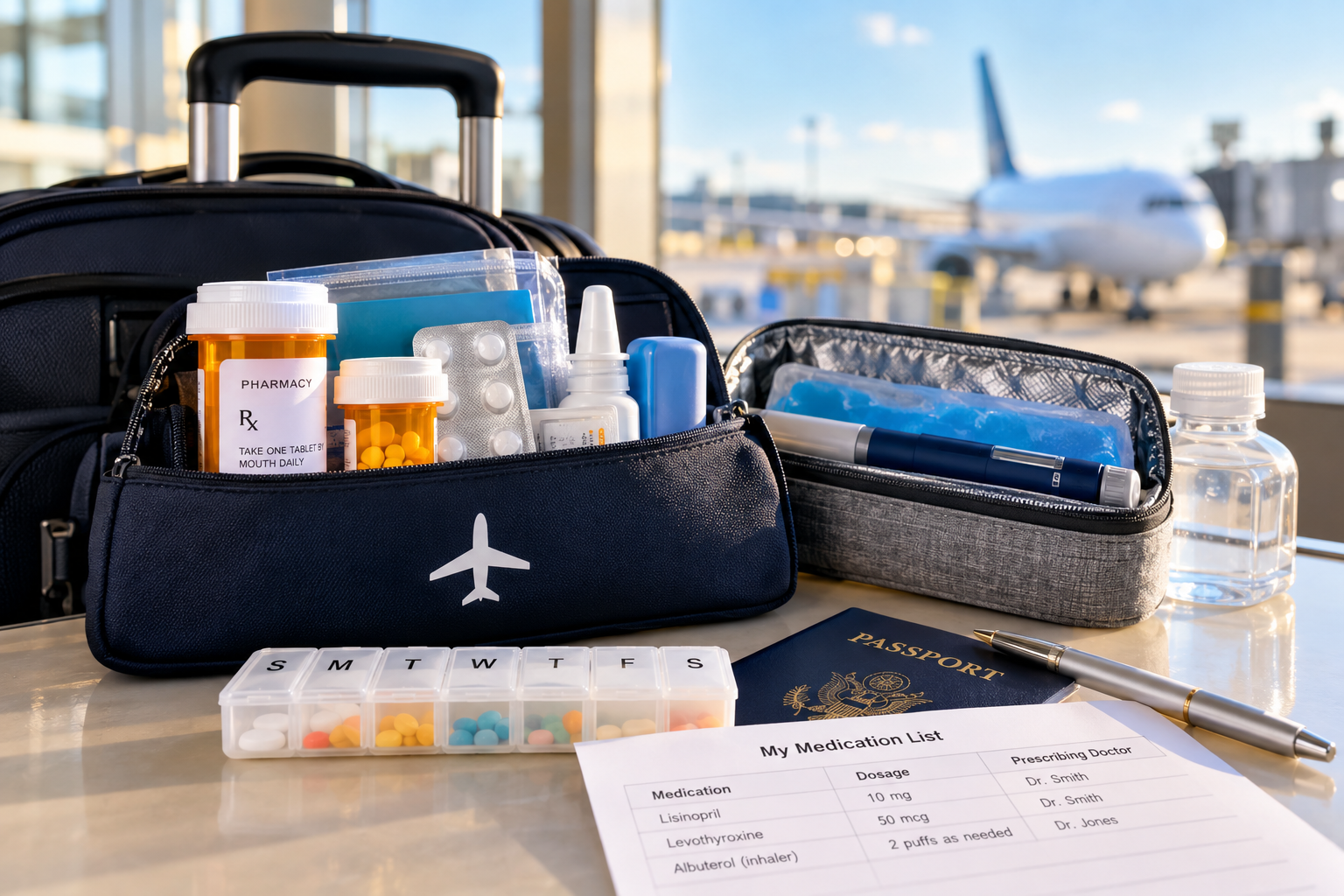
I like keeping important medical items together rather than scattered throughout a carry-on.
Depending on your needs, your kit might include your prescription medications, a few basic over-the-counter medications, copies of prescriptions, a medication list, insurance information, necessary syringes or supplies, and a small insulated medication case if needed.
Keep the entire kit somewhere easy to reach.
A Simple Medication Travel Checklist
Before your next trip:
✓ Pack medication in your carry-on, not your checked bag
✓ Bring enough for your entire trip plus extra for delays
✓ Keep prescription medication in its original labeled container for international travel
✓ Bring copies of important prescriptions
✓ Know the generic names of your medications
✓ Bring a doctor's letter when appropriate for controlled or injectable medications
✓ Tell TSA about medically necessary liquid medication
✓ Plan ahead for medications that need refrigeration
✓ Check medication laws for your destination and layover countries
✓ Ask your healthcare provider about dosing when crossing time zones
✓ Keep a medication and allergy list accessible on your phone
The Bottom Line
Traveling with medication doesn't have to be complicated.
For most trips, a little preparation is all it takes: keep important medicine in your carry-on, bring more than you'll need, keep good documentation and plan ahead for anything requiring refrigeration or special supplies.
The biggest thing to remember when traveling internationally is that medication laws don't automatically travel with you. Always check the rules of the country you're visiting before you leave home.
It's a five-minute travel-prep step that can prevent a very big problem at the airport.
View official TSA Guidance here: TSA Guidance
CDC guidance for traveling abroad with medicine: CDC Guidance
This article is intended for general travel information and is not medical advice. Medication requirements and international regulations can change. Always verify current requirements with TSA, your destination country's appropriate government or embassy resources, and your healthcare provider or pharmacist before traveling.