
Packing Tips
The Best Carry-On Luggage: How to Choose the Right Bag for Your Trip
October 6, 2026
Disclosure: Some links in this post may be referral or affiliate links. If you use them, we may earn a commission at no extra cost to you. See our Affiliate Disclosure.
If you’ve decided to travel with just a carry-on, congratulations, you’ve already eliminated one of the biggest travel headaches.
No waiting at baggage claim. No worrying about whether your suitcase made the connection. And no dragging a giant suitcase through train stations, hotel lobbies, cobblestone streets, or up three flights of stairs.
But choosing the right carry-on matters more than you might think.
A bag that works perfectly for a long weekend in Florida might not be the best choice for two weeks in Europe. And the beautiful suitcase that glides effortlessly through an airport terminal may suddenly become a lot less appealing when you're carrying it up the stairs of a small hotel.
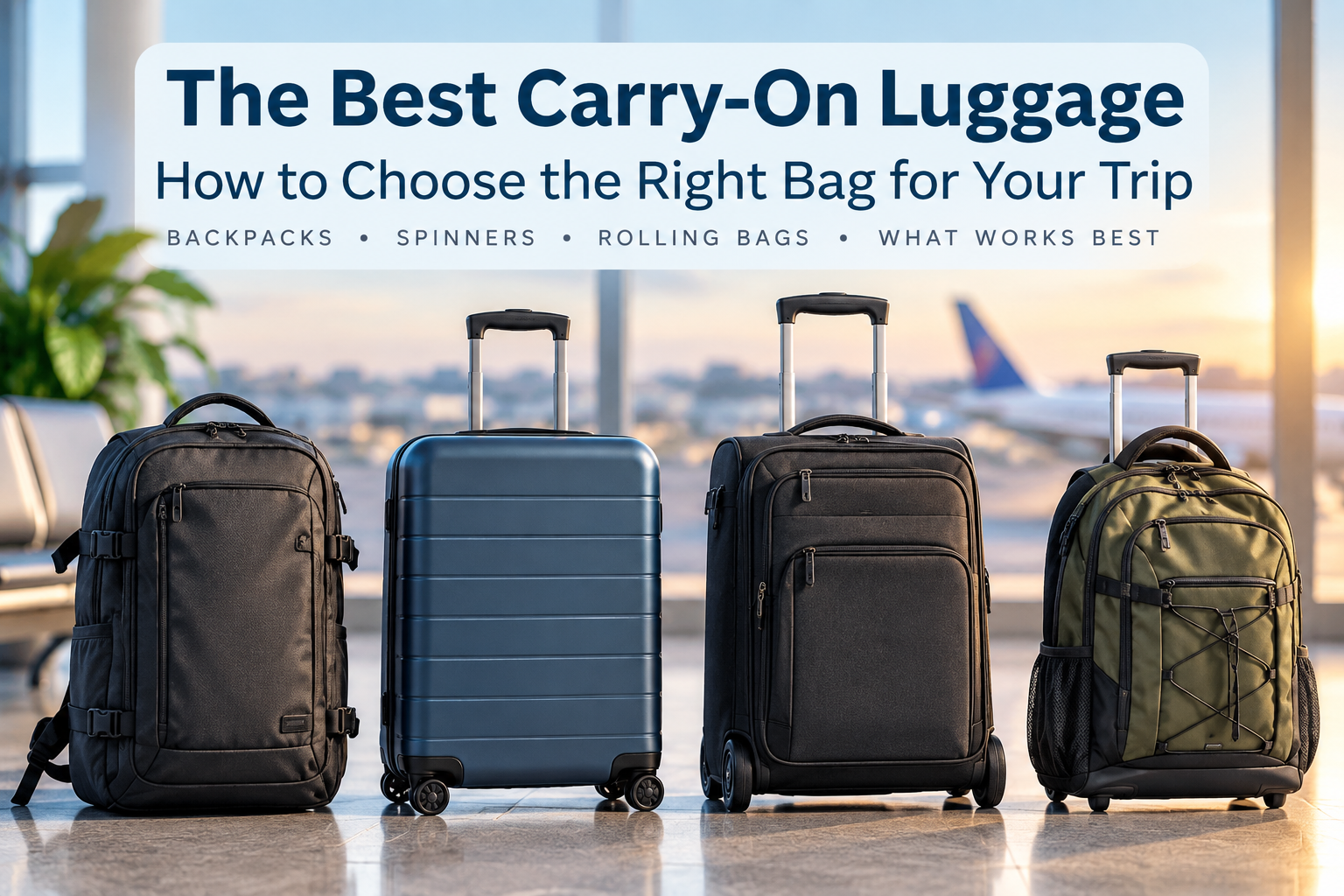
So which is best: a rolling suitcase, spinner, backpack, or rolling backpack?
There isn't one answer for everyone. Here's what to consider.
First: Check the Carry-On Size
Before falling in love with any bag, make sure it will actually qualify as a carry-on for the airlines you fly most often.
Airlines set their own baggage size and weight requirements, and international and low-cost carriers can be more restrictive than major U.S. airlines.
Also pay attention to how the manufacturer measures the bag. Wheels and handles count toward the airline's dimensions, even if they're not included in the interior packing measurements advertised for the suitcase.
What Matters Most in a Carry-On?
Before choosing a particular brand or style, think about how you actually travel.
Weight
An empty suitcase shouldn't use up a huge portion of your baggage allowance.
This becomes especially important internationally, where some airlines have much lower carry-on weight limits than U.S. travelers may be used to.
And remember: even if your bag has wheels, there will be times when you'll have to lift it into an overhead bin, carry it up stairs, get it onto a train, or haul it over an uneven surface.
Lighter is usually better.
Usable Packing Space
Two bags with similar outside dimensions can have surprisingly different amounts of usable space.
Wheels, handles and internal frames all take up room.
Look for a bag with a simple interior that makes good use of the available space. Compression panels or straps can also help.
And if you're trying to travel for a week or longer with only a carry-on, packing cubes are your friend.
Mobility
Think beyond the airport.
Will you be:
• Taking trains?
• Using public transportation?
• Walking several blocks to a hotel?
• Navigating cobblestones?
• Staying somewhere without an elevator?
• Moving between several destinations?
The more frequently you'll be moving, the more important the weight and maneuverability of your luggage become.
Option #1: Four-Wheel Spinner Carry-On
This is probably the style most people picture when they think of a modern carry-on suitcase.
Four-wheel spinners are incredibly easy to maneuver on smooth surfaces. You can push the bag beside you instead of pulling it behind you, which can also be easier on your arm and shoulder.
Best for:
Airport-heavy trips, cruises, resorts, road trips and hotels with elevators.
Advantages:
They're easy to maneuver through airports and hotel lobbies, and you can often place your personal item on top of the suitcase.
The downside:
Those little spinner wheels aren't nearly as impressive once you hit cobblestones, gravel, uneven sidewalks or stairs.
The wheels also take up some of the overall dimensions of the suitcase, leaving slightly less room for your belongings.
Simply Points Take: For many travelers, a lightweight spinner is still the easiest and most practical carry-on, especially if you aren't planning to walk long distances with your luggage. But – its not always the best option for international trips where you will be rolling it over rough surfaces or moving around a lot.
Option #2: Two-Wheel Rolling Carry-On
Two-wheel bags aren't quite as effortless inside an airport, but they can perform better on uneven surfaces.
Their wheels are typically larger and more protected than spinner wheels, which can make them a great choice for trips involving sidewalks, trains and older European cities.
Best for:
European trips, train travel and itineraries involving more walking.
Advantages:
They're generally sturdier on rough surfaces, and the wheel design may take up less interior space.
The downside:
You have to pull the suitcase behind you, which puts some of the bag's weight on your arm.
If your travel is mostly airports, taxis and elevators, you may prefer the convenience of a spinner.
Option #3: Carry-On Backpack
There's a reason you'll see so many experienced travelers walking through Europe with backpacks.
A backpack leaves both hands free and makes stairs, trains and cobblestone streets much easier to navigate.
It can also offer more usable packing space than a wheeled bag because you aren't sacrificing room for wheels and a telescoping handle.
Best for:
Multi-city trips, trains, public transportation, cobblestone streets and travelers who move around frequently.
Advantages:
They're lightweight, flexible and easy to maneuver. Having both hands free is especially convenient when you're buying train tickets, checking your phone for directions or getting on and off public transportation.
The downside:
You have to carry everything on your back.
A bag that feels perfectly comfortable when it's empty can feel very different after you've packed it with clothes, shoes and toiletries.
If you're considering a backpack, load it with approximately the amount of weight you expect to carry and walk around with it before your trip.
Option #4: Rolling Backpack
A rolling backpack sounds like the perfect compromise: wheels when you want them and backpack straps when you don't.
And for some travelers, it is.
But there is a tradeoff.
Adding both wheels and backpack straps increases the weight of the bag and reduces the amount of usable packing space.
If you know you'll use both features regularly, the flexibility may be worth it. But if you expect to roll your bag 95% of the time, you may be better off buying a good rolling suitcase.
Soft-Sided vs. Hard-Shell Carry-On
This one largely comes down to personal preference.
Soft-sided luggage
Soft-sided bags tend to have a little more flexibility, which can be useful when you're trying to squeeze in one last sweater or souvenir.
They also frequently have exterior pockets, something I personally find very useful while traveling.
Hard-shell luggage
Hard-shell suitcases provide more structure and protection.
They're particularly useful if you're carrying something fragile, and many people simply prefer their sleek look.
The downside is that they don't have much give. If the suitcase is full, it's full.
Simply Points Tip: Don't choose based on looks alone. Weight, wheel quality, handle construction and usable interior space matter much more once you're actually traveling.
Features Worth Paying For
You don't necessarily need expensive luggage, but there are a few features worth looking for.
- Good wheels: Cheap wheels can turn a perfectly good suitcase into a nightmare.
- A sturdy telescoping handle: Extend it completely and make sure it doesn't feel overly loose or flimsy.
- Strong zippers and stitching: These are common failure points.
- Comfortable handles: You'll be lifting your bag more often than you think.
- Compression straps or panels: These help maximize your limited carry-on space.
- Exterior pockets: Especially helpful for documents, chargers or items you need to access quickly.
- An expansion zipper: Useful when you come home with more than you left with — although expanding the suitcase may make it too large to qualify as a carry-on.
- A good warranty: Particularly worthwhile if you're investing in more expensive luggage.
Don't Forget About Your Personal Item
Your carry-on is only half of the equation.
Most airlines also allow some type of personal item that fits under the seat, although the permitted size and whether it's included in your fare varies by airline.
Used strategically, your personal item can add a surprising amount of packing space.
A backpack, tote or travel bag can hold things like:
• Medications
• Electronics
• Chargers and power banks
• Travel documents
• A change of clothes
• Snacks
• Toiletries
• Anything you wouldn't want to lose if your carry-on had to be gate-checked
One important note: spare lithium batteries and power banks belong in the aircraft cabin, not in checked baggage. If your carry-on is unexpectedly gate-checked, remove them and keep them with you.
So, What's the Best Carry-On?
It depends on the trip.
For most travelers: A lightweight four-wheel spinner is probably the easiest all-around choice.
For Europe and train-heavy trips: Consider a sturdy two-wheel rolling bag or travel backpack.
For frequent multi-city travelers: A lightweight carry-on backpack gives you maximum mobility.
For travelers who want flexibility: A rolling backpack can work well, as long as you don't mind the extra weight and lost packing space.
The biggest mistake isn't choosing the "wrong" brand.
It's choosing luggage for the airport instead of choosing luggage for the entire trip.
Think about where you'll be walking, how often you'll change hotels, whether you'll encounter stairs, trains or cobblestones, and how much weight you're comfortable carrying.
Then choose the bag that makes that trip easier.
One Last Tip: Don't Let a Bigger Bag Make You Pack More
Whatever bag you choose, resist the urge to fill every available inch simply because it's there.
The goal of carry-on travel isn't just avoiding checked-bag fees. It's being able to move around easily.
A lighter bag is easier to lift, easier to maneuver and a lot more enjoyable to travel with.
And yes — you really can pack for 10 days in a carry-on. I do it all the time.
My Favorite Carry-on Bags
Away – best for Domestic and Work travel
Mother Lode Roller and Mother Lode Backpack – best for Europe
TravelPro – what the experts use. Great bags – softside or hardside in all different sizes!
View all my luggage recommendations here: SHOP
Related Simply Points Travel Resources:
→ My Favorite Travel Essentials
→ Long-Haul Flight Essentials
→ Traveling with Medications